

Sustainable Aviation Fuel (SAF) and California’s Fuel Supply: A New Report
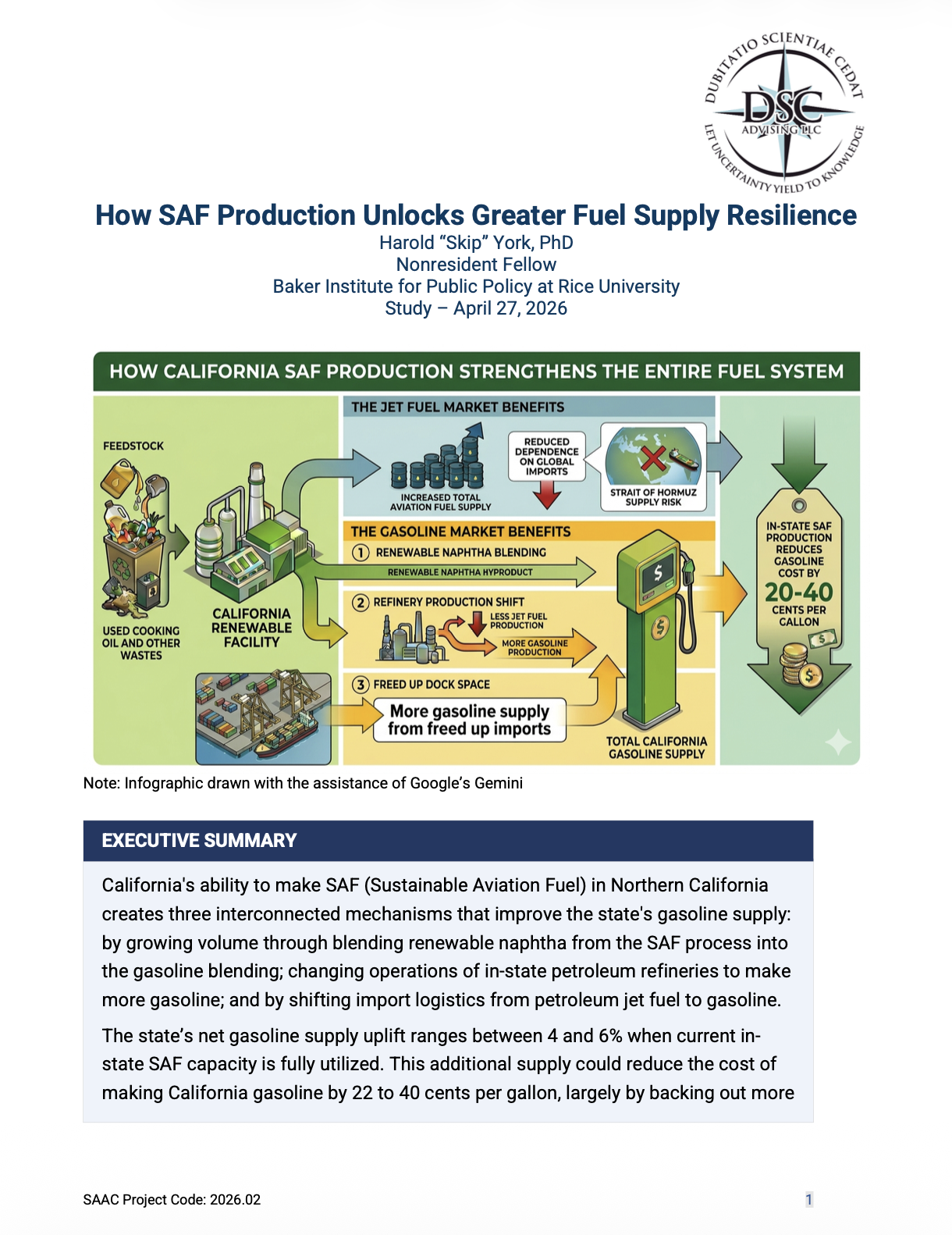
New analysis shows Sustainable Aviation Fuel (SAF) production can expand gasoline supply, lower costs and improve resilience during refinery outages.

About the Sustainable Aviation Advisory Council
The Sustainable Aviation Advisory Council is focused on advancing understanding of Sustainable Aviation Fuel (SAF) and its role in supporting climate goals, fuel supply resilience and energy systems in California and across the United States.
The Council provides clear, accurate and research-based information to policymakers and the public on SAF production and use. We contribute to public discourse by sharing insights grounded in robust data, science and stakeholder input, helping ensure decisions are informed and based on a comprehensive understanding of the transportation fuel system.
Understanding Sustainable Aviation Fuel (SAF) and Fuel Markets
Sustainable Aviation Fuel (SAF) and the Global Jet Fuel Crisis
Dr. Harold “Skip” York, PhD on SAF and Fuel Supply Resilience
Dr. Skip York explains how Sustainable Aviation Fuel (SAF) can help stabilize California’s fuel market. By integrating non-petroleum jet fuel sources, SAF acts as a “flexibility lever,” reducing reliance on foreign crude and strengthening resilience during global disruptions.
The Role of Sustainable Aviation Fuel (SAF) in Fuel Market Resilience
Dr. Harold “Skip” York, PhD on SAF and California Gasoline Supply
Dr. Skip York explains how local production of Sustainable Aviation Fuel (SAF) can strengthen California’s fuel market. SAF enables refineries to shift toward more gasoline production and frees up import capacity—boosting supply by up to 5% and lowering costs by 20 to 40 cents per gallon.

Six Assumptions and Facts about California’s Proposed Sustainable Aviation Fuel (SAF) Credit
The Sustainable Aviation Advisory Council finds the debate about the SAF credit in the California Governor’s 2026-27 budget somewhat one-sided at this point. We believe that the UC Berkeley Haas blog and the Legislative Analyst’s Office (LAO) report fundamentally missed the mark with questionable assumptions and a lack of understanding of how markets and supply chains respond to shifts in supply. As a non-partisan advisory council with an educational mission, we feel compelled to contribute to the ongoing policy debate with the following short list of assumptions and facts.
Our Partners



Frequently Asked Questions
Sustainable Aviation Fuel (SAF) is a renewable jet fuel that can reduce aviation emissions. Energy companies, airlines and governments are investing in SAF as a key solution for more sustainable air travel. Below are answers to common questions about how SAF is produced, its benefits and how it’s used today.
-
What is sustainable aviation fuel (SAF)?
Boeing, Airbus, and other airplane and engine manufacturers are making future products compatible with 100% SAF (by 2030 or earlier).
An important difference is that producing and combusting SAF yields much lower greenhouse gas emissions relative to traditional conventional jet fuel on a lifecycle basis.
-
SAF is produced by refining renewable and waste materials into fuel that meets jet fuel specifications. There are multiple technological pathways to create SAF, all of which involve converting biological feedstocks into hydrocarbon molecules similar to those in conventional jet fuel. The common method used today is the HEFA process (hydroprocessed esters and fatty acids), which processes oils or fats (like used cooking oil or plant oils) into jet fuel. Additional approved pathways include alcohol-to-jet (ATJ) (converting renewable ethanol or isobutanol into jet fuel) and synthetic iso-paraffins from fermented sugars.
Despite the many production routes available, all SAF must meet the same strict specifications as conventional Jet A fuel. The final product is a hydrocarbon fuel that, when blended with conventional jet fuel, meets all standards for compatibility and is nearly indistinguishable in performance from the fuel used by today’s aircraft. you through the next steps and answer any questions along the way.
-
Only 8 million gallons of SAF were sold in California in 2021, which made up 0.3% of the total Low Carbon Fuel Standard (LCFS) credits sold.
California aims to increase SAF availability to 200 million gallons by 2035, which would translate to 40% of its aviation fuel needs for air travel within the state.
-
Many major airlines around the world have begun using SAF as part of their sustainability initiatives. In the US United Airlines, Delta Air Lines, American Airlines, Alaska Airlines, JetBlue, and others have all operated flights using SAF.
-
The SAF Grand Challenge is an ambitious multi-agency commitment by the United States to scale up the production of SAF to 35 billion gallons per year by 2050, with a near-term goal of 3 billion gallons per year by 2030. In addition, SAF produced under this challenge much achieve a minimum of 50% reduction in greenhouse gas emissions. This strategy is led by the U.S. Department of Energy (DOE), U.S. Department of Agriculture (USDA), and Department of Transportation (DOT) with support from the Environmental Protection Agency (EPA) and other federal partners.
A Third Way report projects that reaching the U.S. SAF Grand Challenge could result in up to 153,000 direct jobs, supporting nearly 250,000 additional jobs across the broader economy
Connect with us
For media, research or policy-related inquiries, we welcome you to connect with our team.
Email: info@safadvisory.org